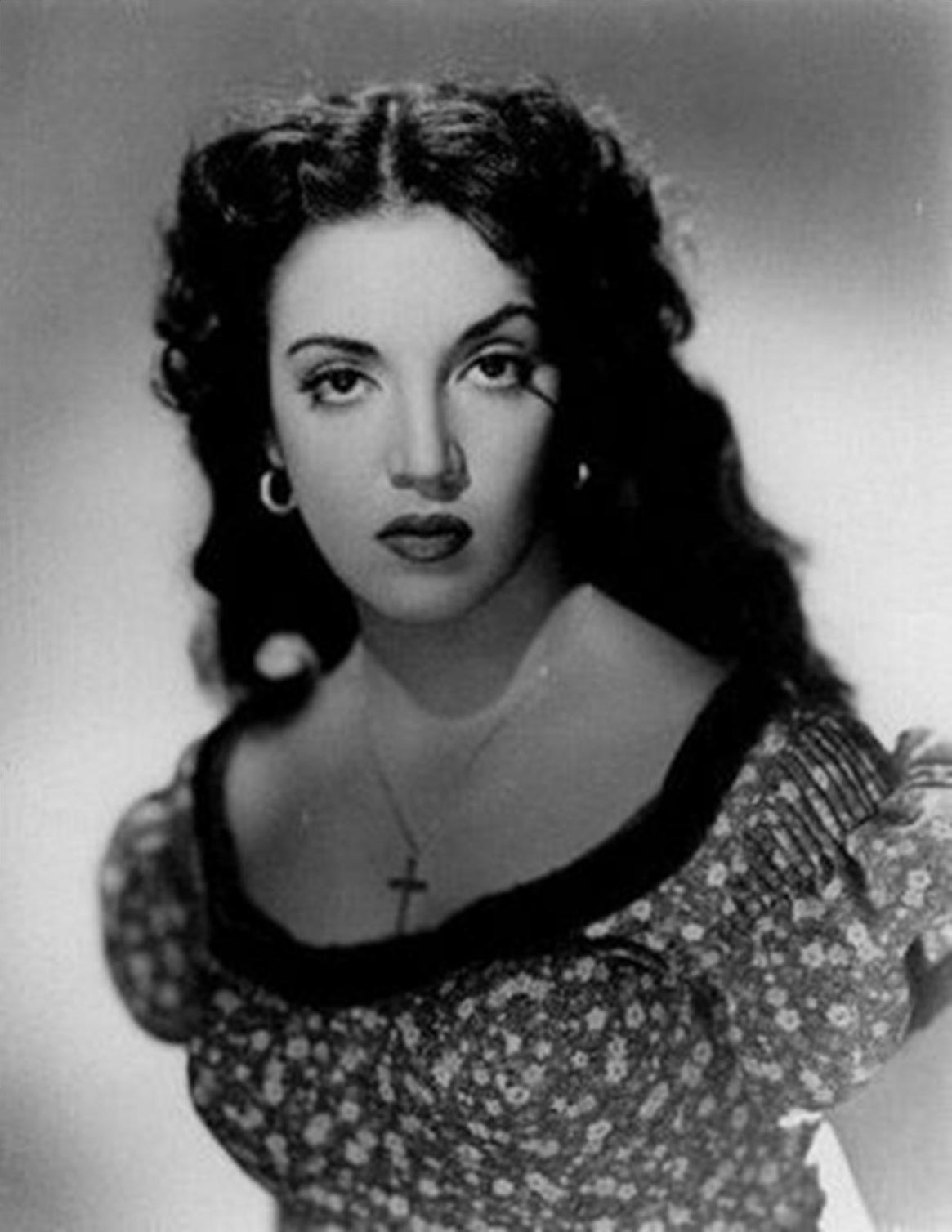
Katy Jurado: The Fierce Life Behind a Hollywood Legend
Katy Jurado’s life contained the kind of contradictions usually reserved for fiction. She came from a privileged Mexican family yet became famous for playing women marked by hardship, danger, and survival. She resisted the rules of her upbringing, crossed into Hollywood without initially seeking it, and became a pioneering figure whose intensity could not be reduced to a stereotype.
A privileged origin and a fiercely guarded identity
María Cristina Estela Marcela Jurado García was born on January 16, 1924. Even the place of her birth has been reported inconsistently, with Guadalajara, Cuernavaca, and Mexico City appearing in different accounts. That uncertainty fits a woman who carefully controlled what the public could know about her.
Her family background was unmistakably prominent. Her father, Luis Jurado Ochoa, was a lawyer, rancher, and orange producer. Her mother, Vicenta García, was a singer who worked in Mexican radio and was related to composer Belisario de Jesús García. Katy was also related to Emilio Portes Gil, president of Mexico from 1928 to 1930. Earlier generations of both sides of the family had held enormous tracts of land, including property in what later became Texas.
The Mexican Revolution destroyed much of that wealth. The family lost land and fortune, but not its sense of social position. Katy was raised in a strict, religious environment and initially imagined a future in law, following her father’s profession. Acting was not considered a respectable path for a young woman of her background.
The marriage that opened the door to acting
As a teenager, Katy attracted attention from filmmakers, including Emilio “El Indio” Fernández. Her parents rejected the idea of an acting career, and the family even threatened to send her away to an institution in Monterrey. Rather than surrender, she signed a film contract in secret.
Marriage became her way out. Katy married actor Víctor Velázquez, not because she described the union as a great romance, but because it freed her from parental control and allowed her to work. The marriage was brief and produced her two children, Víctor Hugo and Sandra. By the time it ended, it had served the purpose she needed most: it had given her independence.
Her formal screen debut came in No matarás in 1943. Mexican filmmakers quickly recognized that she possessed something unusual. She was not presented as the gentle ingénue. Her dark eyes, sensual presence, and commanding manner made her a natural choice for seductive, dangerous, and morally complicated characters. During the golden age of Mexican cinema, she appeared in more than a dozen films while raising her children as a divorced mother.
She supported her family through several kinds of work. Alongside acting, she wrote film columns, reported for radio, and worked as a bullfighting critic. That last role became the bridge to an international career.
From the bullring to Hollywood
At a bullfight, director Budd Boetticher and actor John Wayne noticed Katy. Boetticher cast her in Bullfighter and the Lady, filmed in Mexico in 1951. She accepted partly because the production did not require her to abandon her home country. Her English was still limited, so she learned her lines phonetically.
Her performance attracted producer Stanley Kramer, who cast her as Helen Ramírez in High Noon. This time, Katy refused to rely on memorization alone. She studied English for two hours a day over two months and built a performance around dignity, intelligence, and emotional authority.
The role changed her place in cinema. She won the Golden Globe for Best Supporting Actress and became the first Latin American actress to receive the award. She was also recognized as a promising newcomer. In the film, she stood opposite Gary Cooper and Grace Kelly without being reduced to an exotic accessory. Helen Ramírez was a fully realized woman with history, judgment, and agency.
Katy remained proud of her Mexican identity. She objected to performers who went to Hollywood and abandoned the qualities that had made them distinctive. Her goal was never to become a pale imitation of an American star. She wanted to appear as a Mexican woman with her own cultural reality intact.
In 1953, Diego Rivera painted her, adding an artistic tribute to an already remarkable rise. Her achievement became even more significant when she received an Academy Award nomination for her work in Broken Lance. She was the first Mexican actress nominated for an Oscar.
Love, violence, and the cost of survival
Katy’s private life was as dramatic as her professional one. She had relationships with celebrated men, including John Wayne, Tyrone Power, and Marlon Brando. Her connection with Brando lasted in an intermittent, difficult-to-define form for years. She later called it a “loving friendship,” while biographies and contemporary accounts often described it as a romance. The ambiguity was typical of Katy’s approach to her own story.
She also remembered novelist Louis L’Amour with particular regret. He wrote her love letters until the end of his life, and Katy later said she sometimes thought she should have married him. It was a rare glimpse of vulnerability from a woman more often described as formidable.
Her second marriage, to actor Ernest Borgnine, became the darkest chapter of her adult life. The courtship had been intense, and Borgnine initially treated her with adoration. According to Katy’s later accounts, the marriage turned abusive. She described nighttime attacks, jealousy, threats, and public humiliation. On one occasion in Rome, she was left injured and later appeared at the Venice Film Festival with her arm hurt.
The relationship moved through repeated separations and reconciliations. Katy eventually found the strength to leave after her son Víctor Hugo confronted Borgnine and warned him not to hurt her again. She sought a divorce and a restraining order. The marriage ended in the early 1960s, but the psychological damage remained. Katy fell into a severe depression, experienced suicidal thoughts, and withdrew from Hollywood for several years.
Rebuilding a career on her own terms
Katy returned to work gradually. She appeared in American and Mexican productions, including Stay Away, Joe with Elvis Presley. For the role, she gained significant weight in a short period and worked despite a broken foot, which contributed to a visible limp in the finished film.
Her strongest later performance came in the Mexican film Fe, Esperanza y Caridad. She played Eulogia, a working-class woman battling bureaucratic indifference while trying to claim the remains of her dead husband. The role moved far beyond the seductive figures of her youth. Katy considered it her best performance, and it earned her the Ariel Award for Best Actress.
She also returned to Broadway and continued moving between Mexican cinema, Hollywood, and theater. Her independence sometimes produced conflict. A dispute with Mario Vargas Llosa during Pantaleón y las visitadoras led to her dismissal and a legal challenge. She also shared the screen with María Félix and, later, Dolores del Río—two encounters that placed several towering Mexican actresses of different generations in the same cinematic story.
The loss that changed everything
In 1981, Katy’s son Víctor Hugo died in a car accident near Monterrey. He was the child who had defended her during the Borgnine years, and his death shattered the structure she had built around herself.
She was filming when the news arrived. She attended the funeral and returned to the set because the production continued. Later, she said that her son had taken half of her life and that she had not been able to grieve as she wanted. She also admitted that she came to hate the camera because she felt she had given cinema time that should have belonged to her children.
Katy withdrew, remained in mourning, and struggled with alcohol. Director John Huston eventually persuaded her to return for Under the Volcano in 1984. Acting did not erase her grief, but it gave her a path back into the world. Her later career was more selective, yet she continued to work with the discipline that had defined her from the beginning.
A legend confronting age and oblivion
In the 1990s, Katy reached a new audience through Mexican television, appearing in Más allá del puente and Te sigo amando. She won recognition as a leading actress and later earned another Ariel for El evangelio de las maravillas. Juan Gabriel celebrated her with the song “Qué rechula es Katy,” while further honors acknowledged her contribution to cinema and the western genre.
Yet recognition did not eliminate her loneliness. Living in Cuernavaca, she faced heart and lung problems and underwent several operations. She spoke about death without theatricality. What frightened her was not dying, but losing her independence—needing diapers, losing the ability to think clearly, or becoming dependent on others. She had even chosen the dress she wanted to wear for burial.
Her bitterness was directed less at mortality than at the entertainment industry’s habit of forgetting. After decades of work, she felt that performers who had given their lives to cinema were treated as disposable once the spotlight moved on.
The final contradiction
Katy Jurado died at her home in Cuernavaca on July 5, 2002, at the age of 78. Her death followed kidney and pulmonary illness and cardiac arrest. She was buried at the Panteón de la Paz in Cuernavaca, close to the place where she had chosen to spend her final years.
At the same time, her name remained fixed on the Hollywood Walk of Fame at 7065 Hollywood Boulevard. The quiet cemetery and the celebrated star represent the two worlds she inhabited: Mexico, where her identity was rooted, and Hollywood, where she broke barriers while resisting assimilation.
Katy Jurado’s legacy is not simply that she was the first Mexican actress nominated for an Oscar or the first Latin American woman to win a Golden Globe. It is the example of a performer who refused to be domesticated by family, studios, husbands, genres, or age. She played women who frightened and fascinated the world because she understood power, vulnerability, and survival from the inside.
She left behind a career marked by triumph, abuse, grief, and defiance. The woman remembered for her fierce eyes spent much of her life refusing to look away—from injustice, from heartbreak, or from death itself. That refusal is why Katy Jurado remains more than a star. She remains a force.