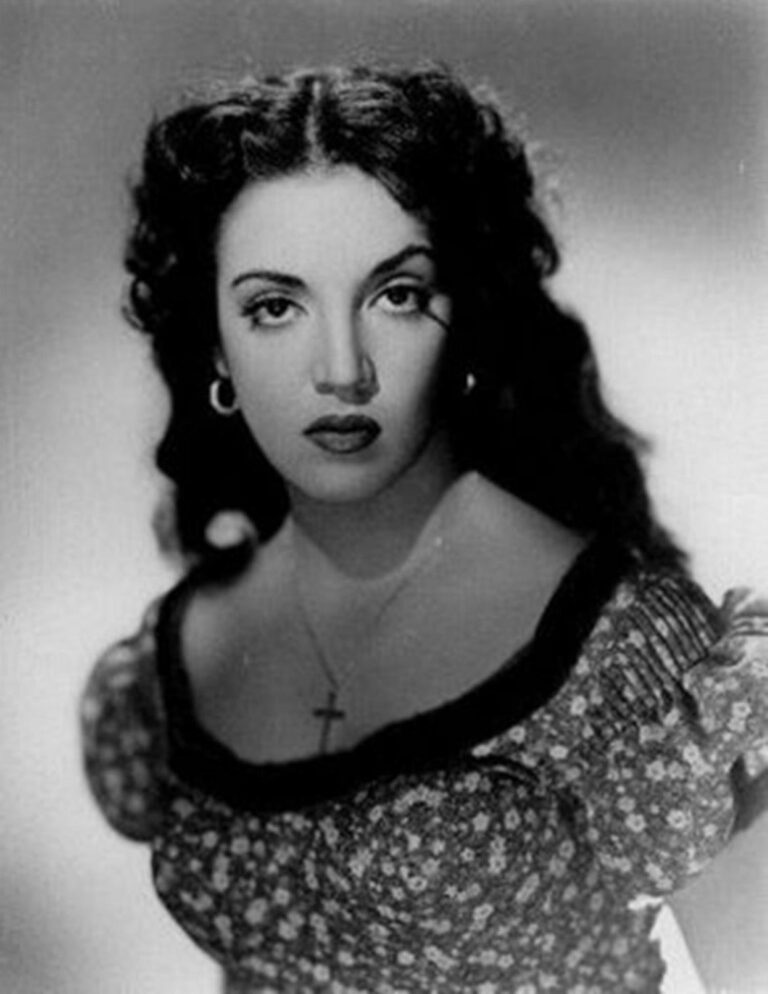
Gloria Marín: A Life That Deserved Its Own Spotlight
Gloria Marín is often remembered through the name of Jorge Negrete. That is understandable: their eleven-year relationship became one of the defining romances of Mexico’s Golden Age of cinema. Yet the familiar version of the story leaves out the woman at its center. Marín was an accomplished actress, a tireless performer and a pioneer who successfully carried her career from popular theater to film and then to television.
Her life contained romance, loss, professional reinvention and a determination that deserves to be remembered on its own terms. The great love of her life was important, but it was only one part of a much larger story.
A childhood behind the curtain
Marín was born in Mexico City on April 19, 1919. Accounts of her birth contain variations in her given names, but they agree that she came from a theatrical family. Her mother, María Laura Ramos Luna, performed under the name Laura Marín and led her own theater company. Gloria adopted her mother’s professional surname, a choice that reflected both gratitude and loyalty to the woman who raised her and introduced her to the stage.
She grew up among curtains, costumes, musicians and traveling performances rather than in the ordinary routine of schoolyards and family homes. The theater was her childhood. According to biographical accounts, she was only five when an absent singer created an unexpected opening at a popular tent theater. The little girl stepped onto the stage and sang an Argentine tango, “La Mocosita.” Instead of being overwhelmed, she captivated the audience.
By six, she was performing more regularly. In Mexico City’s popular theaters and tent shows, audiences came to know her as “la precoz Glorina,” a nickname that captured both her age and her unusual confidence. She worked alongside established performers and learned the discipline of live entertainment, where there are no retakes and no editing to conceal a mistake.
That early education gave Marín qualities that later translated powerfully to the screen: timing, concentration, emotional directness and the ability to hold an audience with a look. Her presence was not manufactured in a studio. It was built through years of performing in front of demanding crowds.
From the stage to the screen
Marín married for the first time at fifteen, to traffic officer Arturo Vargas. The union was brief, but the decision reflected a trait that would remain visible throughout her life: she made choices for herself, even when they challenged convention.
Her film debut came in 1938 with Los millones de Chaflán. Mexican cinema was entering a period of extraordinary growth, and Marín quickly established herself as more than a decorative leading lady. She could handle comedy, melodrama and emotionally demanding roles with equal authority. Film by film, she built a reputation based on ability rather than celebrity alone.
In the early 1940s, she was already an experienced professional when she was cast in ¡Ay, Jalisco, no te rajes! The production would change the direction of her personal and professional life by bringing her together with Jorge Negrete.
The beginning of a legendary romance
Their first impressions were far from romantic. Marín reportedly found Negrete arrogant, overbearing and impossible to tolerate. Negrete, a classically trained baritone with a strong personality and immense confidence, was not immediately comfortable with her either. Both were forceful performers, and their early interactions were marked by friction.
Working together day after day transformed that friction into attraction. Their chemistry became impossible to ignore, both privately and on camera. But their relationship began under complicated circumstances. Negrete was married to actress Elisa Cristi, who was expecting their daughter, Diana. Cristi sought a divorce in 1942 after learning about the relationship.
Marín and Negrete then began a life together that lasted roughly eleven years. Although the public and the press often treated them as husband and wife, they never legally married. Their partnership existed as a domestic union and as a powerful public image, but not as a civil marriage.
Together they appeared in eleven films, including Historia de un gran amor and Seda, sangre y sol. Audiences saw more than fictional romance in those productions. They saw a real couple whose affection seemed to continue beyond the frame. Marín was not simply the famous singer’s companion; she was a substantial performer whose talent helped make their films enduring successes.
Loss, adoption and a relationship under strain
The couple wanted children of their own, but a pregnancy ended in miscarriage in 1947. In an era when private grief was rarely discussed publicly, Marín continued working while carrying the loss quietly. The experience became one of the deepest sorrows of her life.
Marín and Negrete later adopted a daughter, Gloria Virginia Guadalupe, affectionately known as “La Yoyis.” For a time, the family appeared to complete the image of the celebrated couple. But the demands of fame increasingly pulled them in different directions.
During tours through South America in the mid-1940s, tensions reportedly grew. Some accounts have connected the strain to rumors involving Argentine singer Hugo del Carril and to Negrete’s jealousy. There is no conclusive proof of an affair, and the story belongs to the realm of rumor rather than established fact. What is clearer is that travel, long separations, grief and expanding careers placed the relationship under sustained pressure.
Their separation was gradual rather than explosive. When one was working in Mexico, the other might be abroad. Negrete’s international popularity demanded constant travel, while Marín also maintained her own professional commitments and cared for their daughter. The absences accumulated until the relationship could no longer be sustained in the form it had once taken.
By 1951, the partnership was effectively over. In 1952, Negrete described the breakup publicly as a “divorce,” even though they had never been legally married. He said their occupations had drawn them apart and that the affection between them had cooled. The arrangement left La Yoyis in Marín’s care.
The shadow of María Félix
The end of Marín’s relationship with Negrete was followed quickly by his marriage to María Félix. That marriage transformed a private separation into a permanent piece of Mexican popular mythology.
Marín and Félix had encountered each other years earlier. When Félix made her film debut in El Peñón de las Ánimas opposite Negrete, he reportedly preferred Marín for the female lead and treated the newcomer coldly. A decade later, Félix became Negrete’s wife. The coincidence encouraged the public to frame the two actresses as rivals: Marín as the long-term partner who came first, and Félix as the glamorous woman who shared his final years.
That contrast was compelling, but it also reduced Marín. Félix was a master of public image and a commanding presence in the cultural imagination. Marín was more restrained and less interested in turning private pain into spectacle. In the competition for lasting public memory, silence often loses to drama.
A difficult second marriage
Marín tried to rebuild her personal life with actor Abel Salazar. After dating, they married legally on May 31, 1958. This time there was an official ceremony and a civil record, unlike her eleven-year union with Negrete.
The marriage did not provide the stability she hoped for. It lasted only about two years and ended in 1960 after a bitter legal conflict. The irony was painful: the only man Marín officially married was not the partner with whom she had shared the longest and most famous relationship.
After the divorce, she largely stopped pursuing romantic relationships and placed her energy in her work. That decision marked the beginning of an important professional reinvention.
Seeing the future in television
By the early 1960s, Mexico’s Golden Age film industry was weakening. Studios were under pressure, audience tastes were changing and many established stars found themselves pushed aside in favor of younger faces. For performers associated with the earlier era, television was often regarded as a lesser medium or even as a sign that a film career had ended.
Marín saw the situation differently. Her years in popular theater had taught her to value work over prestige. Rather than cling to a disappearing industry, she embraced the new medium and became one of the pioneers of Mexican television.
She appeared in early telenovelas, including Laena and Hermanos Coraje, and remained visible to audiences who had never seen her Golden Age films. She continued acting in cinema during the 1960s and 1970s as well, adapting to new genres and a changing industry.
Her later work brought further recognition. She won two Diosas de Plata, one for Mecánica Nacional, Luis Alcoriza’s sharply observed 1971 black comedy, and another for Presagio. These honors mattered because they confirmed that Marín was not merely a relic of an earlier generation. She remained a serious, capable actress decades after her first appearances.
A later generation knew her through the television phenomenon Mundo de juguete, in which she played a mother superior. The role introduced her to children and families who may not have realized that the warm, familiar performer had once been one of Mexico’s leading film stars.
The final years
Marín’s career lasted more than four decades. The stage and the camera remained the constants in a life marked by changing relationships, professional upheaval and private grief. Her long-standing smoking habit, once associated with glamour in the entertainment world, eventually damaged her health. She developed emphysema and suffered serious respiratory complications.
She died in Mexico City on April 13, 1983, just days before her sixty-fourth birthday. Records differ slightly regarding her age, but the official account attributes her death to irreversible cardiorespiratory failure, acute pulmonary edema and sepsis connected to her lung disease.
Her remains were cremated, but the later whereabouts of her ashes became unknown. The absence of a clearly marked final resting place adds another sorrowful dimension to a life already touched by public erasure.
Remembering Gloria Marín on her own terms
The contrast between Marín’s posthumous memory and Negrete’s is striking. When Negrete died in 1953, Mexico mourned on a national scale. His body was returned from Los Angeles on a government aircraft, his funeral drew enormous crowds and his grave became a place of continuing pilgrimage.
Marín, who had shared eleven years of his life, eleven films and a family with him, received no comparable monument. Even her death record reportedly listed her as divorced from Negrete, despite the fact that they had never been legally married. The mistake is more than a bureaucratic curiosity. It symbolizes how easily her identity was absorbed into his.
Her adopted daughter, Gloria Virginia Guadalupe, remained connected to Marín throughout her life and died in Mérida, Yucatán, in January 2022. She was a living link to the family Marín and Negrete had tried to build together.
Gloria Marín deserves a fuller place in Mexican cultural history. She was a child performer who mastered the hardest form of theater, an actress who appeared in nearly one hundred films, a prize-winning artist, a television pioneer and a professional who kept working when an entire industry changed around her.
She also endured heartbreak without allowing it to define every choice she made. Her relationship with Jorge Negrete was important, but it did not create her talent. Long before that romance, she had already become “la precoz Glorina,” the fearless child who stepped onto a stage and filled an empty space. Long afterward, she was still performing, adapting and earning the affection of new audiences.
The fairest way to remember Gloria Marín is not as someone’s abandoned partner, rival or footnote. It is to remember a woman who built a life through discipline, courage and work. She loved a legend, but she was a legend in her own right.