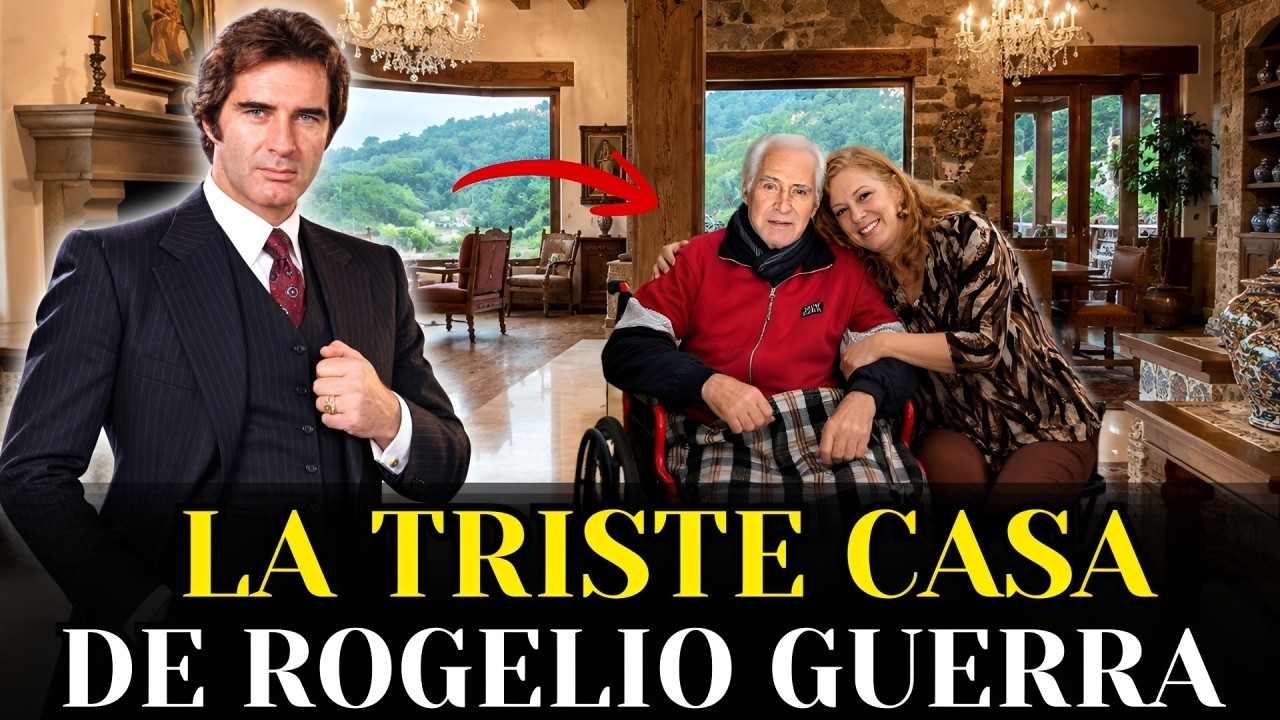
Rogelio Guerra: From Telenovela Icon to a Life Marked by Loss and Loyalty
Rogelio Guerra’s life contained the kind of contrast usually reserved for melodrama: a boy from Aguascalientes became one of the most recognizable faces in Spanish-language television, only to endure financial ruin and profound illness decades later. Yet the final chapter of his life was not defined only by loss. It was also shaped by loyalty, family, professional friendships, and the quiet dignity of being cared for at home.
A difficult beginning
Guerra was born in Aguascalientes on October 8, 1936, as Hildegardo Francisco Guerra Martínez. His parents, Guadalupe Martínez and Juan de Dios Guerra, came from working families in Durango and Jalisco. After they divorced, he had to become self-reliant at an early age. There was no privileged path into show business waiting for him and no influential family connection to guarantee a career.
His appearance became his first opportunity. Tall, striking, and naturally magnetic, he worked as a model to earn a living. Acting was not initially a childhood dream. A chance introduction through the singer and actor Óscar Chávez opened the door to the artistic world, and Guerra began building a career almost by accident.
His early film work included the Mexican westerns sometimes nicknamed “enchilada westerns”—low-budget adventures filled with gunfighters, horses, dusty landscapes, and Mexican settings. Films such as El Solitario, Tierra de Violencia, Vuelve el Texano, and Rancho Solo gave him practical experience and helped establish him as a promising young leading man.
The name behind the star
The actor eventually chose the professional name Rogelio Guerra, leaving the more unusual Hildegardo behind while retaining his family surname. The change helped create a memorable screen identity, but he did not completely abandon his birth name. He later gave a feminine form of it to his daughter, a private link to the person he had been before fame.
His career moved from film into television as Mexican telenovelas grew into a major cultural force. In 1967, however, his progress was interrupted by a mysterious television ban after his participation in El derecho de nacer. The precise reason was never made clear publicly. Whether it resulted from a dispute, an executive decision, or an internal industry conflict, the ban forced him to rely on cinema and theater while television doors remained closed.
Guerra did not stay away forever. He waited, adapted, and continued working until a role arrived that transformed his career.
International fame
In 1979, Guerra was cast as Luis Alberto Salvatierra in Los ricos también lloran, opposite Verónica Castro. The production combined the classic elements of melodrama—class differences, lost children, jealousy, betrayal, separation, and redemption—with a central romance that audiences found impossible to resist.
The series became a phenomenon in Mexico and then traveled far beyond the country. It was sold to many territories and dubbed into several languages. In the former Soviet Union, broadcasts were remembered for empty streets and audiences organizing their evenings around the story. Guerra’s face became familiar from Latin America and Spain to Russia and regions of Central Asia.
The success brought him wealth, recognition, and lasting status within the industry. He continued appearing in successful productions through the 1980s and 1990s, including Vanessa, Amalia Batista, Chispita, Principessa, Vivir un poco, and Ángeles blancos. His deep voice also made him a sought-after performer in dubbing. He was no longer merely a handsome newcomer; he had become one of Mexico’s respected first actors.
A complicated personal life
Guerra’s romantic image was inseparable from his work, but his private life was more complicated than the idealized romances he played on screen. He married three times. His relationship with actress and dancer Otilia Larrañaga lasted several years and produced a daughter. He also had other children, including Rogelio Ramón, Fedra, Carlo, and Aldo.
In the 1980s, he married Maribel Robles, daughter of horror-film legend Germán Robles. Their marriage lasted approximately 34 years, until Guerra’s death. Robles understood the demands and pressures of acting, but her most important role in his life came after his public triumphs had faded. She became his principal advocate and caregiver during the most difficult period he would face.
The legal battle that changed everything
At the beginning of the 2000s, Guerra moved from Televisa to its competitor, TV Azteca. The agreement was reportedly intended to include several productions. He completed Golpe bajo with Lucía Méndez in 2002, but the promised work that followed did not materialize according to Guerra’s account.
He sued, arguing that the agreement had not been honored, and an initial ruling favored him. TV Azteca then filed a countersuit, alleging that Guerra had failed to appear for a production and that the company had suffered financial losses. Guerra maintained that he had never received the call in question. The dispute became a contest between the actor’s account and that of a powerful corporation.
The litigation continued for more than a decade. A later federal judgment ordered Guerra to pay 26 million pesos in damages. The ruling had consequences that reached far beyond a court figure. His home, bank accounts, savings, and royalties were reportedly seized, and future earnings were subject to withholding. His family said that for years they received virtually no income from his work.
One of the most extraordinary aspects of the case was the reported loss of commercial rights to the name “Rogelio Guerra.” The identity that had made him famous could no longer be used freely as a professional asset. For a performer, losing a home and savings is devastating; losing the name that represents an entire career is also deeply personal.
Robles later described a long process of selling cars, insurance policies, and household possessions to cover basic needs. Guerra, once an international star, reportedly accepted appearances in costume—including portrayals of historical figures—to earn money. The story illustrates how quickly an extended legal conflict can consume the financial security built over a lifetime.
Illness and the fight to bring him home
Robles believed that the prolonged stress of the dispute contributed to Guerra’s Alzheimer’s disease. That is her account, not a medical conclusion that can be established from the public record alone. What is clear is that the legal and financial pressure coincided with a devastating decline in his health.
Guerra’s condition worsened as the disease advanced. In 2015, he suffered a stroke that left him unable to walk or speak and dependent on constant care. After the family’s resources had been exhausted, Robles placed him in a care facility for actors who lacked the means to pay for specialized treatment.
According to Robles, the arrangement quickly became unacceptable. She said he was not receiving adequate care, experienced medical complications, and fell into a deep depression. After several months, she brought him home in January 2016 and assumed responsibility for his care with the help of their children.
That decision created another financial crisis. Nurses and a specialized hospital bed reportedly cost about 30,000 pesos a month. A physician, Dr. Israel Falkenstein, agreed to cover those expenses for the remainder of Guerra’s life, explaining that he wanted to repay the actor for the credibility and prestige he had brought to the profession. Verónica Castro also publicly sought help for her former co-star and remained attentive to his condition.
A peaceful final chapter
At home, Guerra spent his final years surrounded by Robles, his children, nurses, and people who cared about him. The goal was no longer recovery but comfort, dignity, and companionship. Robles described that period as an effort to give him quality of life and love when medicine could no longer reverse the damage.
Guerra died at home in Mexico City on February 28, 2018, at the age of 81. He had eaten breakfast and seemed in good spirits that morning. Later, he experienced breathing problems. A paramedic who was caring for him helped stabilize him briefly, but a second respiratory arrest around midday proved fatal. He died in his own bed, with family and caregivers nearby.
His final wish was to be cremated and have his ashes scattered at sea. The family honored that request. After years in which his home, money, professional identity, and health had been taken from him, the ocean became a place no court could claim and no debt could seize.
What remains
Rogelio Guerra did not receive the kind of ending found in the telenovelas that made him famous. He did not recover his fortune, his professional name, or his memory. But his life cannot be reduced to its collapse. He rose from hardship, built an international career, and left an enduring mark on audiences across borders.
More importantly, when he could no longer protect himself, his wife brought him home. A physician helped make round-the-clock care possible. Former colleagues remembered him. His family stayed close. Those acts of devotion restored a measure of dignity after years of public and private hardship.
Material success can disappear through litigation, illness, or time. The affection an artist creates is harder to erase. Guerra remains remembered as the elegant leading man whose performances shaped the memories of generations—and as a man whose final years showed the value of loyalty when fame and wealth were no longer enough.