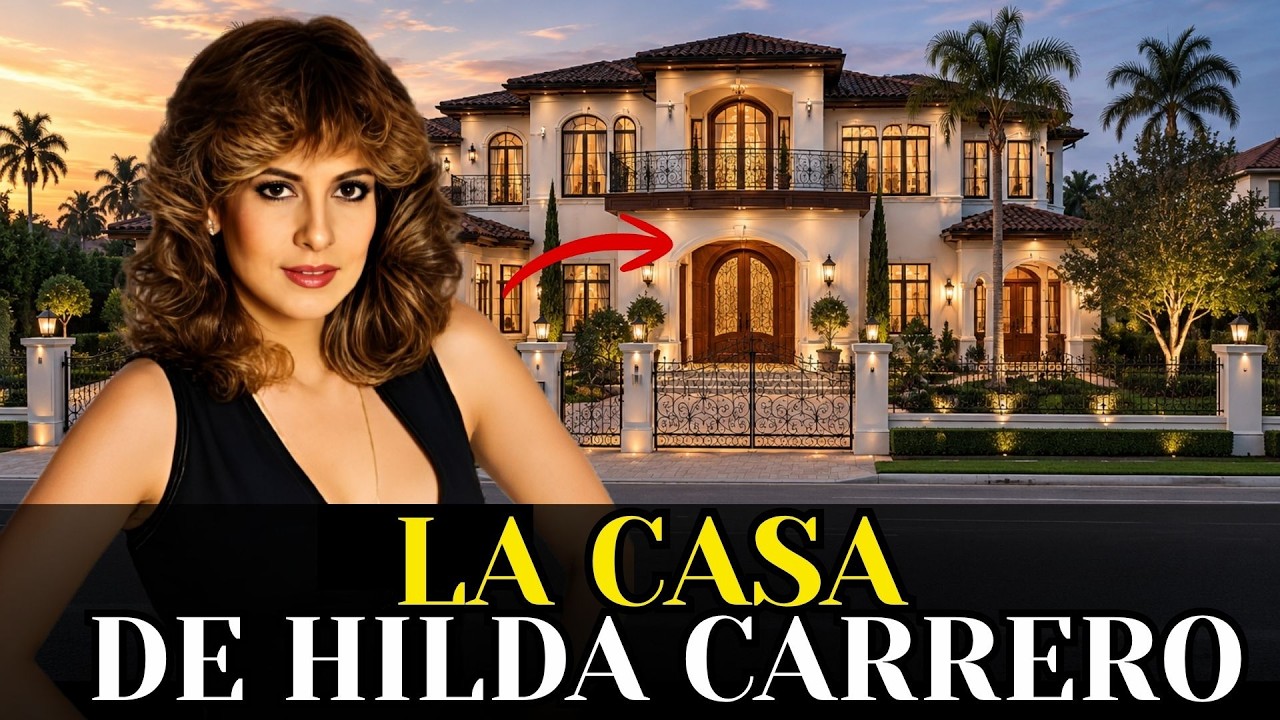
Hilda Carrero: The Star Who Chose Love and Privacy
Hilda Carrero’s life was unusual not because she sought fame, but because she knew when to step away from it. She became one of Venezuela’s most admired television actresses, enjoyed a celebrated on-screen partnership, and earned affection across Latin America. Yet, at the height of her success, she chose a private family life over continued stardom. Her story is one of beauty, hard work, enduring love, and extraordinary discretion.
From Caracas to the world of pageants
Hilda Elvira Carrero García was born in Caracas on December 26, 1951. Her family brought together two different Venezuelan backgrounds: her father came from San Cristóbal in the Andean state of Táchira, while her mother was from Caracas. That combination of regional roots and capital-city modernity formed part of the background of a woman who would eventually become a national television favorite.
Her beauty was immediately striking, but Carrero was never defined by appearance alone. She studied at the Universidad Santa María in Caracas and earned a degree in business administration, giving her an academic and professional foundation uncommon among many beauty contestants of her generation. Behind the gentle features that admirers described as angelic was a serious, disciplined, and well-educated woman.
In 1973, at the age of 21, Carrero competed in the Miss Venezuela pageant representing Táchira. Accounts differ slightly about her exact placement, with records describing her as fourth overall or as the third runner-up. Whatever the precise ranking, the contest opened an international door. She went on to represent Venezuela at Miss International in Japan, where she placed among the 15 finalists.
The following year, she competed in the International Coffee Queen pageant in Manizales, Colombia, and finished as first runner-up. Within two years, Carrero had become recognized not only in Venezuela but also in the international pageant circuit.
Building a career beyond beauty
Carrero did not treat pageant success as the end of her ambitions. She moved into acting, first gaining experience in commercial theater and working alongside established performers. The stage gave her the discipline required to sustain a character in front of a live audience.
Her early television years were a gradual climb rather than an instant transformation into a star. She worked with Venezolana de Televisión and Radio Caracas Televisión, accepting small and supporting roles while learning the demands of the camera. She appeared in a number of productions, including the police series Patrulla 88, before receiving a leading role.
This patient beginning mattered. Carrero’s looks may have helped her enter the industry, but consistent work earned her credibility. She developed the emotional warmth and restraint that would later make her especially effective in romantic and dramatic roles.
The two words that made her beloved
A turning point came in 1979 with the telenovela Emilia. Carrero played Nereida Pardo Figueroa, a supporting character whose affectionate nickname for the man she loved became unexpectedly popular. She called him “Mi Puchi.”
The phrase spread far beyond the show. Viewers began using it in everyday life as a tender term of affection, and Carrero became associated with a kind of fame built on warmth rather than controversy. She had not captured the public through scandal or provocation. She had reached people through sweetness, familiarity, and a screen presence that felt close to home.
That same year, after years of smaller parts, she received her first leading role in Migaja. Carrero was no longer simply a recognizable beauty or a promising supporting performer. She had become a leading actress capable of carrying an entire story.
A legendary television partnership
Carrero’s greatest period of television success was closely connected to actor Eduardo Serrano. Together, they formed one of Venezuela’s most memorable romantic pairings. Their chemistry was immediate and powerful, and producers reunited them repeatedly for more than a decade.
On screen, they played lovers who endured betrayal, separation, hardship, and reconciliation. Viewers followed their fictional romances with such devotion that the two performers became linked in the public imagination. Their partnership was professional, however, grounded in friendship, respect, and years of shared work rather than a confirmed romantic relationship away from the cameras.
The pair appeared together in several important productions, including Sorel in 1982, La Heredera, and Julia in 1983. Carrero also took on roles that became especially important to her legacy. In Las Amazonas in 1985, she played Isabel Lizárraga, a character many viewers remembered as the beautiful Amazon. In 1986, she portrayed Magdalena Pimentel de Serpa in El Sol Sale para Todos, a major success that reached audiences well beyond Venezuela.
By the middle of the 1980s, Carrero had achieved what many performers spend an entire career pursuing. She was a leading actress, an international television name, and half of a beloved romantic partnership. Her programs reached viewers throughout Latin America, and her popularity was firmly established.
Choosing a family life over the spotlight
At the height of that success, Carrero met Juan Fernández, a Portuguese-Venezuelan businessman whose life was outside the entertainment industry. Their relationship became the defining love of her personal life. They married in December 1986, and their marriage lasted until Carrero’s death.
What made the relationship remarkable was not simply the wedding, but the decision Carrero made afterward. She left acting while her career was still flourishing. Rather than continuing to pursue leading roles and public attention, she devoted herself to her marriage, her home, and eventually her two children, João and Joana Fátima.
For an industry built around visibility, this was a striking choice. Many performers continue working because they fear losing public attention; Carrero accepted the possibility of being forgotten. Her education, maturity, and clear sense of priorities helped her make the decision on her own terms. She chose a private family life because that was what she valued most.
She did make a limited return to television in 1991 as host of La Noche Musical on Televen. It was a brief appearance rather than a full return to acting. Her central life remained with her husband and children, away from the cameras and the demands of celebrity.
A private battle with illness
In 1997, when Carrero was 45, doctors diagnosed her with breast cancer. The illness arrived during a period when she had built the peaceful family life she wanted. She faced the diagnosis privately, sharing the details primarily with her husband, children, doctors, and closest circle.
For nearly five years, she underwent treatment in Venezuela and abroad. Those who knew about her condition remembered her determination, optimism, and strength. While much of the public assumed she was simply living quietly in retirement, she was confronting a serious illness largely outside the public eye.
A recollection from the period describes seeing Carrero at a restaurant with her husband and children. Her health was visibly declining, yet she remained affectionate and composed when greeting an old colleague. The image reflects the discretion that defined her final years: she was surrounded by the people she loved and did not turn her suffering into a public performance.
A farewell on her own terms
Carrero died from metastatic cancer on January 28, 2002, at a clinic in Caracas. She was 50 years old. Even in death, she made a final choice that reflected the way she had lived. She asked that news of her passing not be released until after her funeral.
Her wish was honored. Family and close friends attended the farewell, and her burial took place at La Guairita Cemetery in eastern Caracas before the wider public learned what had happened. There were no cameras, no large media spectacle, and no public ceremony organized around her celebrity.
That decision was unusual for a star of her stature, but it was entirely consistent with the life she had chosen after leaving television. Carrero did not want her family’s grief turned into entertainment. She wanted her final moments to belong to the people closest to her, not to the audience that had once followed her every night.
A legacy built on dignity
Hilda Carrero’s legacy is not defined by scandal, public feuds, or a dramatic return to fame. It rests on a quieter achievement. She became a beauty queen without allowing pageants to limit her, an actress who earned her place through persistence, and a television icon whose appeal came from tenderness and emotional sincerity.
She also demonstrated the courage to leave success behind when it no longer matched her priorities. Her decision to choose Juan Fernández and their children over continued celebrity may be interpreted differently by different generations, but it was unmistakably her own. She understood the value of public recognition and still decided that privacy, family, and love mattered more.
She died as she had lived during her later years: quietly, with her family close and her dignity intact. For viewers who remember her romances, her partnership with Eduardo Serrano, or the affectionate expression that made her famous, Carrero remains a symbol of a gentler era of Latin American television. More than a star who disappeared from the screen, she was a woman who knew what she wanted her life to mean—and protected that choice to the very end.